A Comprehensive Analysis of Konjac Manufacturers' Production: Quality Control from Raw Material Selection to Finished Product Processing
Quality control in konjac manufacturers runs through the entire production process. Strict standards must be adhered to at every step from raw materials to finished products to produce safe and high-quality konjac food.
Raw material selection is the source of quality assurance. High-quality konjac mostly comes from producing areas with an altitude of 800-2500 meters, such as Sichuan and Yunnan. Manufacturers will establish exclusive planting bases, requiring konjac tubers to have a diameter of more than 10 cm and a weight of over 500 grams, with no damage or mildew on the skin. During acquisition, a refractometer is used for testing, and high-quality konjac should have a glucomannan content of no less than 6%. Only qualified raw materials enter the cleaning process - sediment is removed through high-pressure spraying, and deteriorated parts are manually removed to ensure the purity of the initial raw materials.
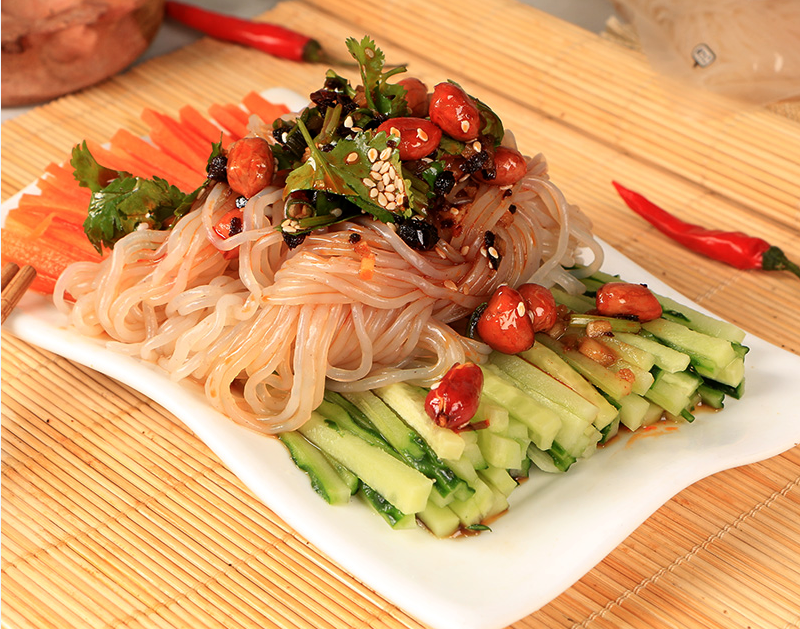
The technology in the processing link determines the product texture. The peeled konjac tubers are first crushed into pulp by a stainless steel grinder, and crude fibers are filtered out through a 120-mesh filter screen to retain the delicate konjac refined powder pulp. The traditional process uses lime water (calcium hydroxide solution) for coagulation, while modern manufacturers have upgraded to food-grade gelling agents. They are stirred in a reaction tank at a constant temperature of 35°C for 2 hours to fully cross-link the glucomannan, forming a tender texture. For ready-to-eat products (such as konjac knots), they need to be cut by a forming mold and then set in 85°C hot water for 30 minutes to avoid deformation in subsequent processing.
The sterilization and packaging links are related to food safety. Konjac products need to undergo double sterilization: first, pasteurization at 95°C for 15 minutes to kill most microorganisms; after vacuum packaging, high-pressure sterilization at 121°C for 30 minutes is carried out to ensure sterility within the shelf life. The packaging material is made of retortable composite film, and the sealing temperature is controlled at 180°C ± 5°C to ensure tightness while avoiding material odor caused by high temperature.
The testing before leaving the factory covers multiple indicators. Each batch of products needs to be sampled and tested: in terms of sensory properties, it is required to have uniform color and no impurities; in physical and chemical indicators, the moisture content is controlled at 85%-90%, and the pH value is maintained at 6.5-7.5; microbial testing must comply with the GB 2713-2015 standard, with the total number of colonies ≤ 10000cfu/g. In addition, heavy metal residues (lead ≤ 0.1mg/kg, arsenic ≤ 0.05mg/kg) must be tested to ensure compliance with international export standards.
Through the triple control of raw material traceability, process standardization, and full-item testing, konjac manufacturers can stably output high-quality products and provide reliable raw material guarantees for the downstream of the industrial chain.